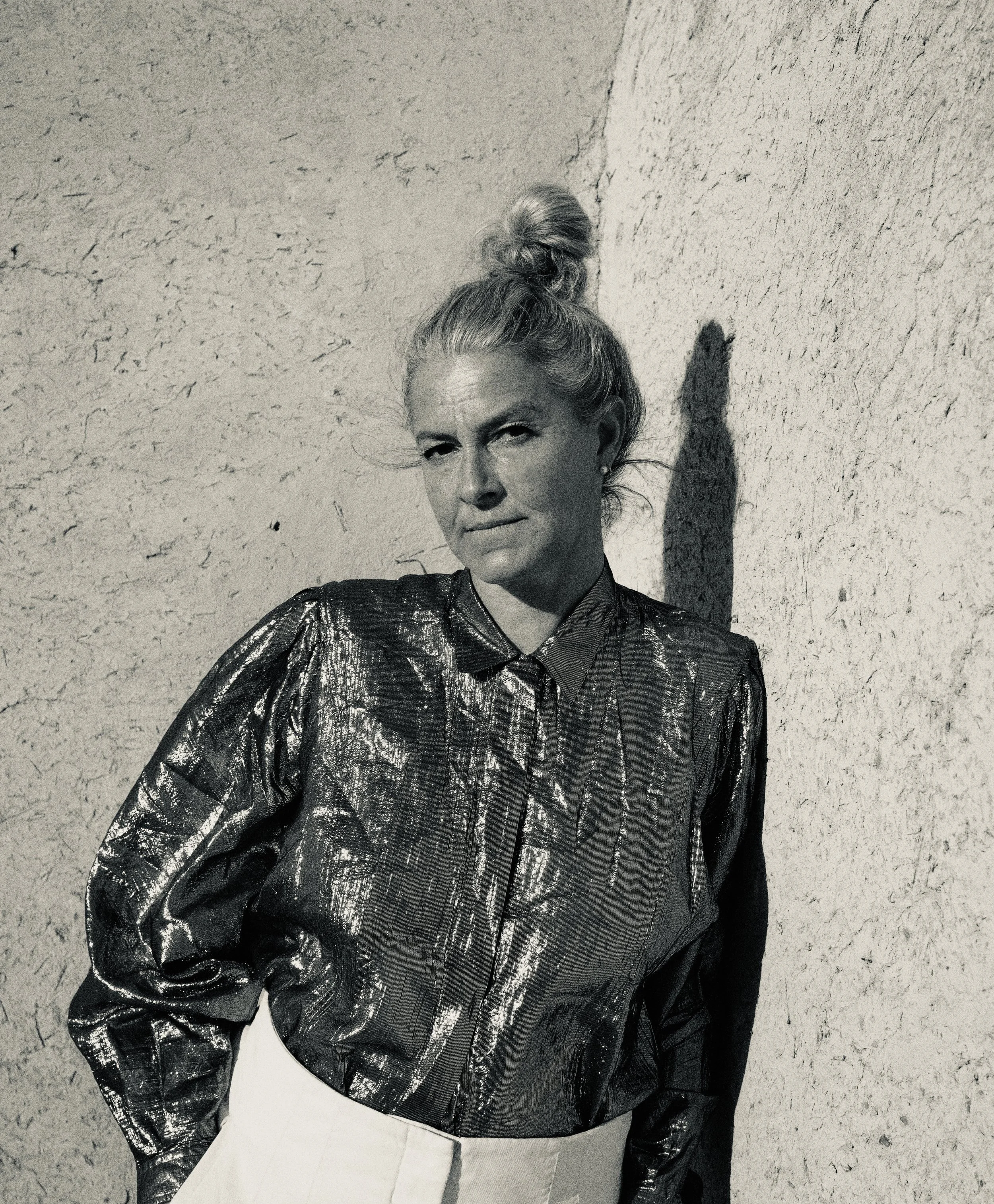
photo Carlota Grau
contact : studio@cecilecarre.com
CÉCILE CARRÉ, Nouméa
*
“Painting today is an act of resistance. The long years required to invent a personal world demand enormous work—sometimes thankless, rarely understood—a considerable effort. The result is seldom guaranteed. Ruptures and a lack of dialogue make the work of many artists difficult to access.
Cécile’s paintings are the result of a lifetime of observation.
Each line, each patch of color vibrates with an invisible music. Everything tells the story of a sense of wonder before the spectacle of the world.
Beauty is surely in the eye of the beholder, but before Cécile’s paintings, beauty blinds us with its presence.
This personal gaze is an explosion of colors and forms.
How does one invent a language? By searching for an expression that might eventually recount, reveal, and allow us to feel fragments of a world of her own, Cécile has slowly transformed her painting.
Over many years, poetic observation has given way to a mature and rich expression.
The paintings of these recent years are the fruit of an artistic fragmentation of the lived world and the world as perceived. This fragmentation appears on two levels: a fragmentation of the whole, and a fragmentation of detail—of colors and forms. The whole is thus separated and intuitively reconstructed in a symphony that is uniquely hers.
Thus, in looking at her paintings, we return to that first observation: to paint is to ‘love again’ (Henry Miller).
To love the beauty of the world. And to make painting a manifestation of existence, often invisible but always present.”
Gezim Pacarizi, architect
*
STATMENT
*
Je viens du monde de l’architecture et du dessin d’observation : une discipline du regard qui apprend à voir avant de dire, à comprendre avant d’interpréter. Pendant des années, durant des voyages d’exploration à la mode du 18ème siècle, mes carnets ont été mon terrain d’apprentissage. J’y ai consigné des fragments d’espace, des études de compositions, des associations de couleurs ou certains effets de matière ; une bibliothèque subjective.
Cette pratique a façonné ma manière de percevoir le monde : le temps long de l’observation compose un langage silencieux. Ma peinture est née là.
Couleurs, formes et matières se recomposent comme les éléments d’une architecture, chaque tableau cherchant une forme qui tient, qui abrite. Je peins pour transformer ces observations en présence. Des éléments épars reprennent sens comme une architecture vernaculaire picturale, protectrice, évidente. Ces compositions évoquent la reconnaissance : la simplicité d’un ensemble qui a trouvé sa place.
Ma peinture vise à réveiller une mémoire essentielle : ce que l’on percevait avant de savoir nommer.
Cette mémoire est intime. Elle est aussi universelle.
Je recherche le Genius Loci — cet esprit propre d’un lieu, sa capacité à nous attirer, à nous rappeler quelque chose d’essentiel.
Dans mes compositions, le réel recomposé devient un point d’ancrage : un espace pour revenir au monde et l’aimer à nouveau.
Voir. Comprendre. Transmettre.
Ce passage-là.
Chacun peut l’emprunter et l’habiter comme tel.
*
Cécile Carré’s practice is rooted in a lifelong discipline of observational drawing.
Trained as an interior designer at the École Boulle in Paris, she spent years travelling and filling sketchbooks with architectural studies - spatial fragments, proportional relationships, material textures - building a personal archive of the visible world drawn from direct observation.
This sustained engagement with space and structure shapes the way she paints. Her work does not begin with emotion, but with attention - the slow, practised act of looking that precedes any interpretation. Over time, these observations sediment into a visual memory: layered, non-linear, resistant to direct transcription.
Painting becomes the process by which this memory is reconstructed according to its own internal logic.
The result is a form of abstraction that carries architectural intelligence. Compositions emerge from what she calls a double fragmentation - a simultaneous dissolution of the whole and of its details - before being reordered into a coherent pictorial structure.
Color, form, and material function as elements of a sensory architecture, each contributing to a spatial equilibrium that feels both constructed and inevitable.
Central to this work is the concept of Genius Loci - the spirit of a place, its capacity to hold memory and transmit presence.
Carré’s paintings do not represent specific locations; they distil the quality of recognition that a place can produce, engaging a form of pre-verbal knowledge - spatial, bodily, collective - that makes the unfamiliar feel familiar, and returns the viewer to the world with renewed attentiveness.”
*
*
Cécile is French and lives in Barcelona.
Interior designer graduated from the École Boulle in Paris, she founded her own interior design firm, MisMAS Interiorismo, Barcelona.
Great traveler, she creates travel diaries of architectural observations and has published a book (Carnet de voyage de Noces, Le Seuil 2003) recounting a year-long trip between Istanbul and Beijing.
*